
The Evolution of Chip Design Strategy
The semiconductor industry is entering a phase that looks strikingly similar to what software went through twenty years ago. Back then, companies had to decide whether to build everything in-house or embrace open-source and move faster. Today, that same question is being revisited in the context of chip design.
The difference is that chips are not just software. They sit at the core of everything from AI infrastructure to national security. The stakes are higher, the timelines are longer, and the consequences of getting it wrong are far more expensive.
For decades, the dominant strategy was clear. Control the architecture, protect the IP, and optimize relentlessly. That model is now supplemented by open architectures such as RISC-V International, along with a growing ecosystem of open tools that make chip design more accessible than ever before.
This creates a fundamental decision for any semiconductor team:
Do you build proprietary chips for control and performance, or adopt open architectures for speed, flexibility, and ecosystem leverage?
The answer is not absolute and in many cases, not strictly either-or.
Understanding Proprietary and Open Architectures
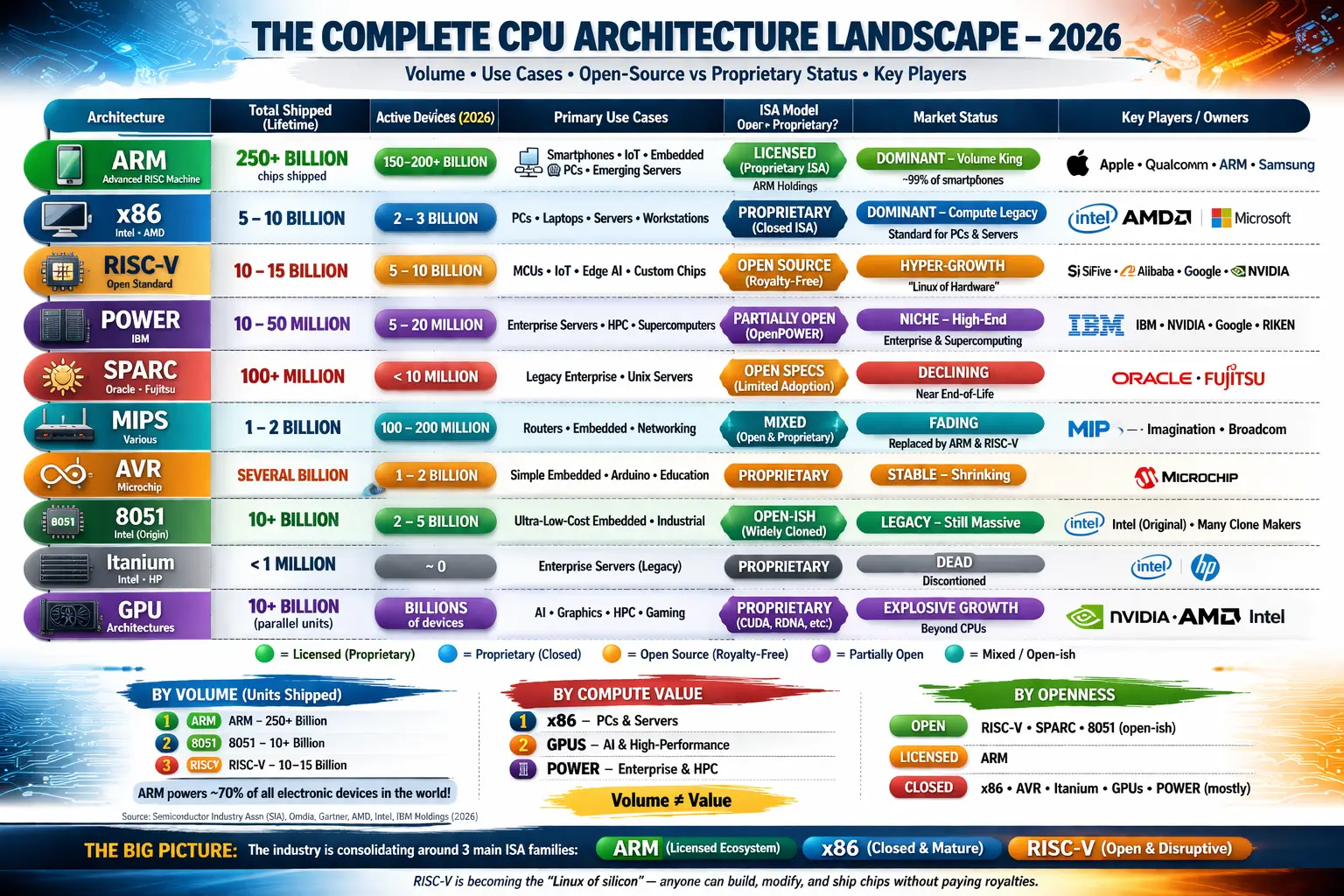
A proprietary chip architecture is built around ownership and control. The instruction set, the microarchitecture, and the surrounding ecosystem are all tightly managed. This is how Intel built the x86 ecosystem, how Arm Holdings created a licensing model that dominates mobile computing, and how Apple delivers tightly integrated performance across its devices.
This approach allows companies to optimize deeply across hardware and software. It also creates strong competitive moats because competitors cannot easily replicate the same stack.
Open architectures start from a different premise. Instead of controlling the foundation, they open it. RISC-V is the most important example. It is an instruction set architecture that anyone can use without licensing fees or restrictions.
However, it is critical to understand that open ISA does not mean fully open chips. A company can use RISC-V as a base and still build proprietary implementations on top. This is where much of the confusion lies and also where much of the opportunity exists.
The real shift is not about replacing proprietary with open but more so, redefining where differentiation occurs within the stack.
Design smarter, scale faster, and win in silicon with yieldWerx.
The Open Silicon Stack Is Changing the Game
What makes this moment different from earlier attempts at open hardware is the maturity of the ecosystem.
It is now possible to design a chip end-to-end using open tools. Engineers can use tools such as Xschem for schematic capture, Ngspice for simulation, and Magic for layout. These, combined with open process design kits such as SkyWater SKY130, allow teams to move from concept to manufacturable design without relying on proprietary EDA software.
The workflow itself is familiar but the accessibility is new. Designers start with schematics, simulate behavior, move into layout, perform verification, extract parasitics, and prepare designs for tapeout. What used to require large corporate infrastructure can now be done by small teams or even individuals.
Projects such as Tiny Tapeout have demonstrated this in practice by enabling community-driven silicon runs. Dozens of designs from different contributors can be fabricated together, dramatically reducing cost and increasing participation.
This shift is not just technical. It changes who can participate in chip design and how quickly ideas can move into hardware.
Competitive Advantage Comes Down to Trade-offs
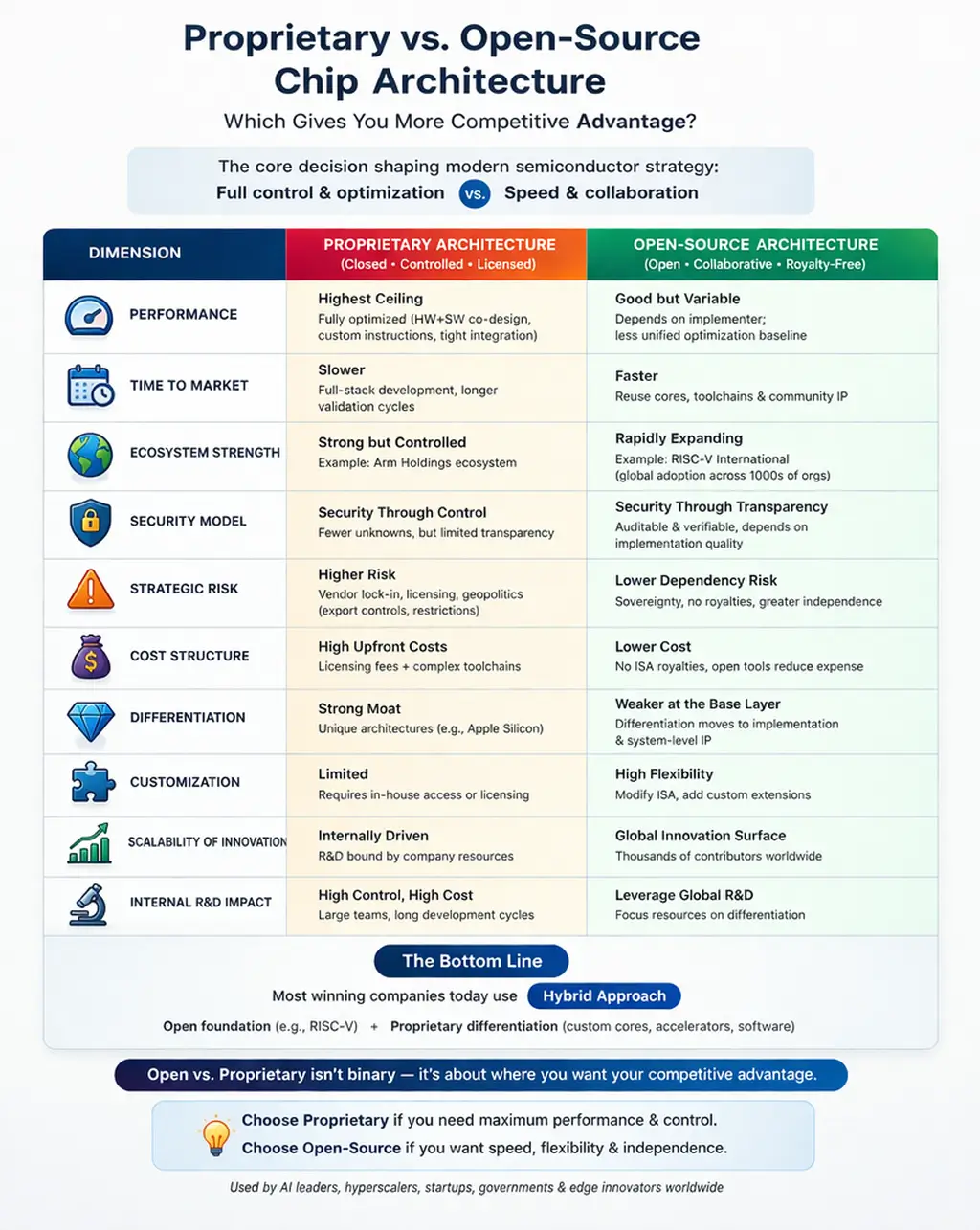
The choice between proprietary and open architectures is ultimately about trade-offs.
Proprietary approaches still offer the highest performance ceiling. Companies that control the full stack can optimize instruction sets, memory hierarchies, and software integration in ways that are difficult to replicate. This is why Apple’s silicon has achieved such strong performance per watt and why NVIDIA maintains leadership in AI.
Open architectures, by contrast, reduce friction. They eliminate licensing costs and extensive contractual paperwork while enabling reuse of existing designs, and allow teams to iterate faster. Instead of spending time building foundational components, engineers can focus on differentiation at higher levels.
Ecosystem dynamics also differ. Proprietary ecosystems are curated and controlled. ARM is a good example where many companies participate but under strict licensing. Open ecosystems evolve more organically, with contributions from startups, universities, and major corporations alike.
Security introduces another dimension. Proprietary systems operate as black boxes. Open systems can be inspected and verified. This does not automatically make them more secure, but it changes how security is approached. It allows independent validation and increases transparency.
Strategic risk is perhaps the most underappreciated factor. Proprietary architectures create dependencies. Open architectures reduce them. In a world where supply chains and geopolitical dynamics are becoming more complex, this matters more than ever.
Real-World Strategies Across Different Segments
The best way to understand which approach works is to look at how different players are making decisions today.
AI and High-Performance Computing
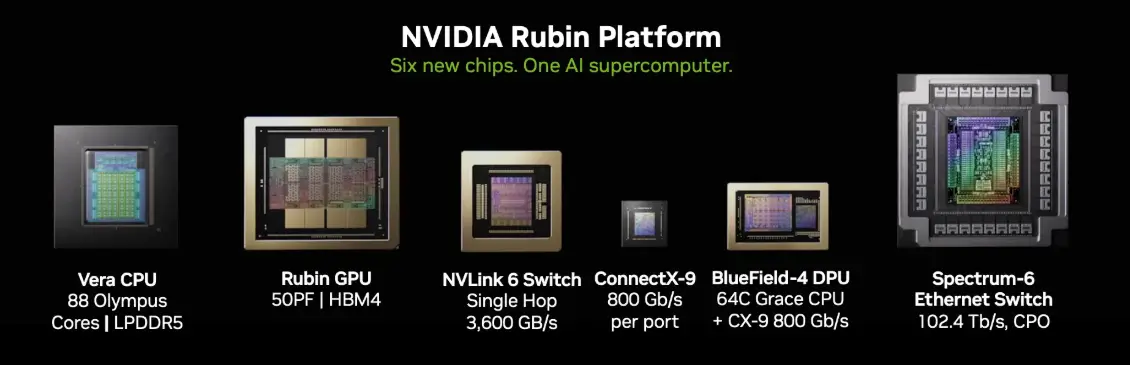
In AI and high-performance computing, proprietary architectures continue to dominate. NVIDIA is the clearest example. Its advantage is not just the GPU hardware but the CUDA software ecosystem that surrounds it. This integration creates a lock-in effect that is difficult for competitors to break.
Similarly, Google has developed its Tensor Processing Units, and Amazon has built custom chips such as Graviton and Inferentia. These are not general-purpose processors. They are highly optimized for specific workloads.
In this segment, performance and efficiency are critical. The cost of suboptimal design is too high. This is why companies invest heavily in proprietary solutions. Control over the entire stack allows them to extract maximum value from their hardware.
Edge, IoT, and Embedded Systems
In edge and embedded systems, constraints differ.
Cost, power efficiency, and scalability matter more than peak performance. This is where open architectures are gaining ground rapidly.
Companies such as Espressif Systems are integrating RISC-V cores into microcontrollers that power everything from smart home devices to industrial sensors. Western Digital has adopted RISC-V for storage controllers, embedding it into billions of devices.
In these markets, the ability to avoid licensing fees and customize designs for specific use cases creates a clear advantage. Open architectures reduce cost and enable faster deployment across a wide range of applications.
Startups and New Entrants
Startups face a different set of constraints. They need to move quickly and operate with limited resources, but they also need to differentiate themselves in a competitive market.
The most effective strategy emerging here is hybrid.
Companies such as SiFive provide RISC-V cores that startups can build upon. At the same time, startups like Tenstorrent are developing specialized AI accelerators that differentiate their offerings.
Instead of building everything from scratch, startups use open architectures as a foundation and focus their efforts on the parts of the system that create value. This approach reduces time to market while still enabling competitive advantage.
Hyperscalers and Cloud Providers

Large cloud providers are increasingly designing their own silicon. Microsoft, Google, and Amazon are all investing in custom chips to optimize their infrastructure.
These companies are not abandoning proprietary approaches, but they are exploring open architectures as part of a broader strategy to reduce dependency on external vendors.
The goal is not just performance. It is also cost control and supply chain resilience. By owning more of the stack, hyperscalers can optimize for their specific workloads and reduce reliance on companies like Intel and NVIDIA.
Governments and Geopolitical Strategy
Perhaps the most significant driver of open architectures is geopolitics.
Countries are becoming increasingly aware of their dependence on semiconductor technology. Access to chips is no longer guaranteed, and reliance on closed architectures introduces risk.
This is why governments in regions such as China, India, and Europe are investing in RISC-V. An open instruction set provides a foundation that cannot be restricted by licensing agreements or export controls.
In this context, RISC-V is not just a technical choice. It is a strategic one. It enables countries to build their own ecosystems and reduce dependency on external suppliers.
The Industry Is Moving Toward Hybrid Models
The most important trend across all these segments is the move toward hybrid strategies.
Companies are not choosing between open and proprietary. They are combining them.
An open ISA such as RISC-V provides flexibility and reduces lock-in. Proprietary extensions, accelerators, and software layers provide differentiation and performance.
This model allows companies to benefit from both approaches. It mirrors what happened in software, where open-source platforms became the foundation for proprietary innovation.
In chip design, this hybrid approach is becoming the default.
Making the Right Decision for Your Business
The choice between proprietary and open architecture depends on your priorities.
If your business depends on maximum performance and tight integration, proprietary architectures offer clear advantages. If speed, flexibility, and cost efficiency are more important, open architectures provide a strong foundation.
For many organizations, the optimal approach lies somewhere in between. The key is to align your architecture strategy with your product goals, market dynamics, and long-term positioning.
From Architecture to Execution: Where yieldWerx Adds Value
Choosing an architecture is only the beginning. The real challenge is turning that choice into a competitive advantage in the market.
A well-designed chip does not automatically translate into success. Yield, variability, and production efficiency determine whether a design can scale and deliver consistent performance.
This is an area where teams often lack visibility. Architecture decisions are often made without fully understanding their impact on downstream manufacturing outcomes.
At yieldWerx, we focus on linking design to measurable production outcomes.
We help semiconductor teams connect design choices with production realities. Whether you are building a proprietary AI accelerator, adopting RISC-V for edge applications, or developing a hybrid architecture, we provide the insights needed to understand how those decisions affect yield, performance, and scalability.
Because in today’s semiconductor industry, advantage is not defined by design alone.
It is defined by how effectively you can bring that design to production and deliver reliable, high-performing silicon at scale.
If you are evaluating your next chip strategy, ensure your architectural decisions translate into production performance.
Turn your architecture decisions into measurable yield, performance, and competitive advantage with yieldWerx.
Contact Us Today To Learn More.